
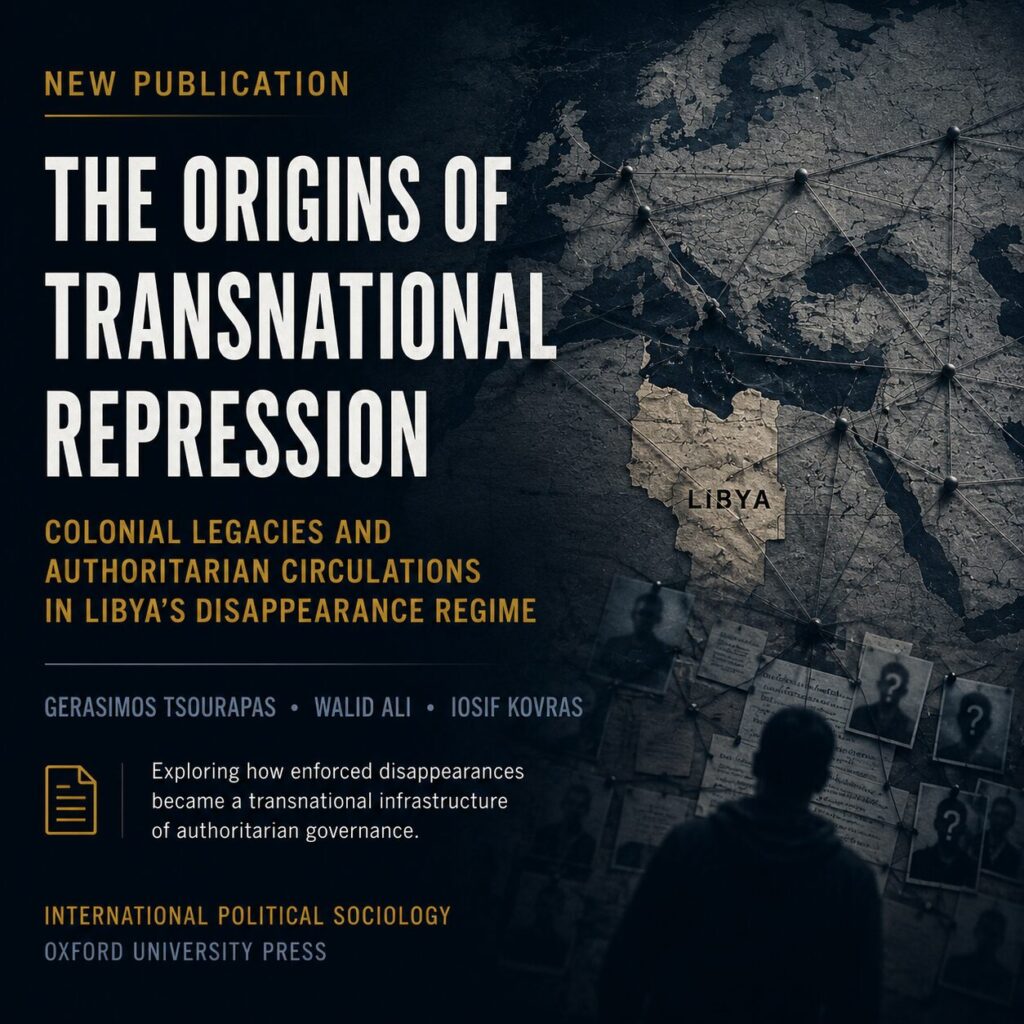
We are pleased to share our latest publication in the International Political Sociology:
The Origins of Transnational Repression: Colonial Legacies and Authoritarian Circulations in Libya’s Disappearance Regime, by Iosif Kovras, Walid Ali, and Gerasimos Tsourapas.
The article traces the evolution of enforced disappearances in Libya across nearly a century, demonstrating how this practice originated under Italian colonial rule, became institutionalized during the Gaddafi regime, and persisted after 2011. Drawing on archival research and interviews with former Libyan detainees and exiles, the authors examine how surveillance, legal erasure, the public stigmatization of families, and cross-border security cooperation sustained a system of transnational repression.
The study argues that enforced disappearance should be understood not only as a domestic tool of repression but also as a transnational infrastructure of authoritarian rule, enabling states to project power beyond their borders and suppress political opposition across regions. In doing so, it contributes to broader debates on transnational repression, authoritarianism, sovereignty, and the enduring legacies of colonialism.
This publication is part of the DISACT – Disappearing Act project and the MIGDIPLO project, funded by the European Research Council.